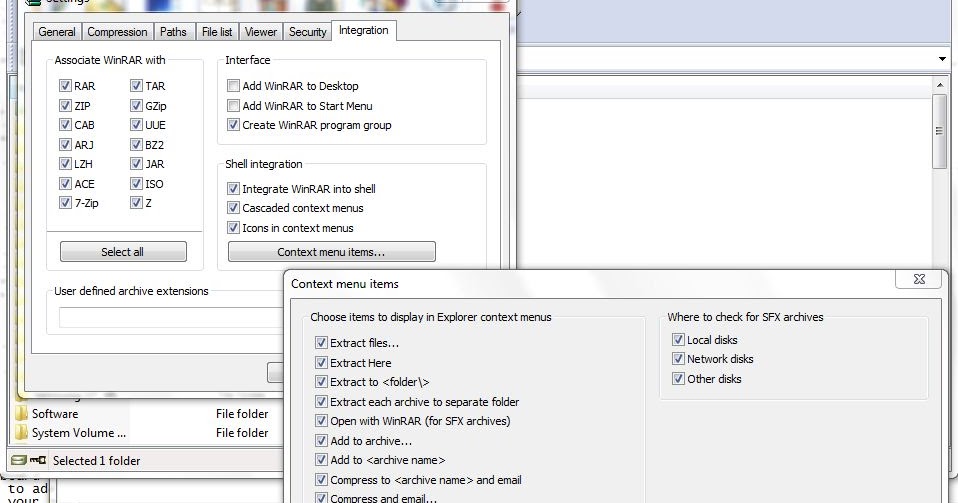
The powerful and advanced archive manager available is WinRAR Crack. WinRAR archiving as well as extraction in your context menu which displayed when you drag. Context Menu Editor latest version: Clear out your redundant context menu entries. Context Menu Editor is a nice, free Windows software. A Free Phone Manager. Jul 18, 2016 Free Download Context Menu Manager 2016.7 - A reliable and intuitive file associations management utility and context menu customization tool that a.
The CContextMenuManager object manages shortcut menus, also known as context menus. Syntax class CContextMenuManager: public CObject Members Public Constructors Name Description Constructs a CContextMenuManager object. CContextMenuManager::~CContextMenuManager Destructor. Public Methods Name Description Adds a new shortcut menu.
Returns a handle to the menu associated with the provided resource ID. Returns a handle to the menu that matches the provided menu name.
Returns a list of menu names. Loads shortcut menus stored in the Windows registry. Clears the shortcut menus from the context menu manager. Saves shortcut menus to the Windows registry. Controls whether the CContextMenuManager closes the active shortcut menu when it shows a new shortcut menu. Displays the specified shortcut menu.
Displays the specified shortcut menu. Returns the index of the selected menu command. Dragon Ball Z Sparking Meteor Ps2 Iso On Ps3. Remarks CContextMenuManager manages shortcut menus and makes sure that they have a consistent appearance. You should not create a CContextMenuManager object manually. The framework of your application creates the CContextMenuManager object. However, you should call when your application is initialized. After initializing the context manager, use the method to obtain a pointer to the context manager for your application.
You can create shortcut menus at runtime by calling AddMenu. If you want to show the menu without first receiving user input, call ShowPopupMenu. Can I Update Cracked Adobe Cs6.
TrackPopupMenu is used when you want to create a menu and wait for user input. TrackPopupMenu returns the index of the selected command or 0 if the user exited without selecting anything. The CContextMenuManager can also save and load its state to the Windows registry. Example The following example demonstrates how to add a menu to a CContextMenuManager object, and how not to close the active pop-up menu when the CContextMenuManager object displays a new pop-up menu. This code snippet is part of the.
// The GetContextMenuManager method is inherited from the CWinAppEx class. GetContextMenuManager()->AddMenu (_T('My menu'), IDR_CONTEXT_MENU); GetContextMenuManager()->SetDontCloseActiveMenu(true); Inheritance Hierarchy CContextMenuManager Requirements Header: afxcontextmenumanager.h CContextMenuManager::AddMenu Adds a new shortcut menu to the. BOOL AddMenu( UINT uiMenuNameResId, UINT uiMenuResId); BOOL AddMenu( LPCTSTR lpszName, UINT uiMenuResId); Parameters [in] uiMenuNameResId A resource ID for a string that contains the name for the new menu. [in] uiMenuResId The menu resource ID.
[in] lpszName A string that contains the name for the new menu. Return Value Nonzero if the method was successful; 0 if the method fails. Remarks This method fails if uiMenuResId is invalid or if another menu with the same name already is in the CContextMenuManager. CContextMenuManager::CContextMenuManager Constructs a object. CContextMenuManager(); Remarks In most cases, you should not create a CContextMenuManager manually. The framework of your application creates the CContextMenuManager object.
You should call during the initialization of your application. To get a pointer to the context manager, call. CContextMenuManager::GetMenuById Returns a handle to the menu associated with a given resource ID. HMENU GetMenuById(UINT nMenuResId) const; Parameters [in] nMenuResId The resource ID for the menu. Return Value A handle to the associated menu or NULL if the menu is not found. CContextMenuManager::GetMenuByName Returns a handle to a specific menu.
HMENU GetMenuByName( LPCTSTR lpszName, UINT* puiOrigResID = NULL) const; Parameters [in] lpszName A string that contains the name of the menu to retrieve. [out] puiOrigResID A pointer to an UINT. This parameter contains the resource ID of the specified menu, if found.
Return Value A handle to the menu that matches the name that was specified by lpszName. NULL if there is no menu called lpszName. Remarks If this method finds a menu that matches lpszName, GetMenuByName stores the menu resource ID in the parameter puiOrigResID. CContextMenuManager::GetMenuNames Returns the list of menu names added to the. Void GetMenuNames(CStringList& listOfNames) const; Parameters [out] listOfNames A reference to a parameter. This method writes the list of menu names to this parameter. CContextMenuManager::LoadState Loads information associated with the from the Windows registry.
Virtual BOOL LoadState(LPCTSTR lpszProfileName = NULL); Parameters [in] lpszProfileName A string that contains the relative path of a registry key. Return Value Nonzero if the method is successful; otherwise 0. Remarks The lpszProfileName parameter is not the absolute path for a registry entry.