I know that you are ready to write the first program. You have been through a lot so far! While we are on the subject, let's recap the events. You went out and purchased the of your choice. I chose the for my uses.

You were introduced to the how they work; and were also introduced to the programmer, the device that helps transfer the program into the microcontroller. You that is used to connect the SPI pins to the correct pins of the microcontroller. You verified that the for the 32-bit and 64-bit versions of Windows (XP, 7 and Vista).
You also installed the programming environment so that you can have an environment in which to write your program, and then transfer it into the microcontroller. And to make sure that everything functions correctly, you used avrdude to while plugged into the computer and the microcontroller. Recall that this program is the program transfer utility to move our compiled program into the memory on the microcontroller. Finally, you built the first circuit so that we could have something to write a program for. That was a lot!
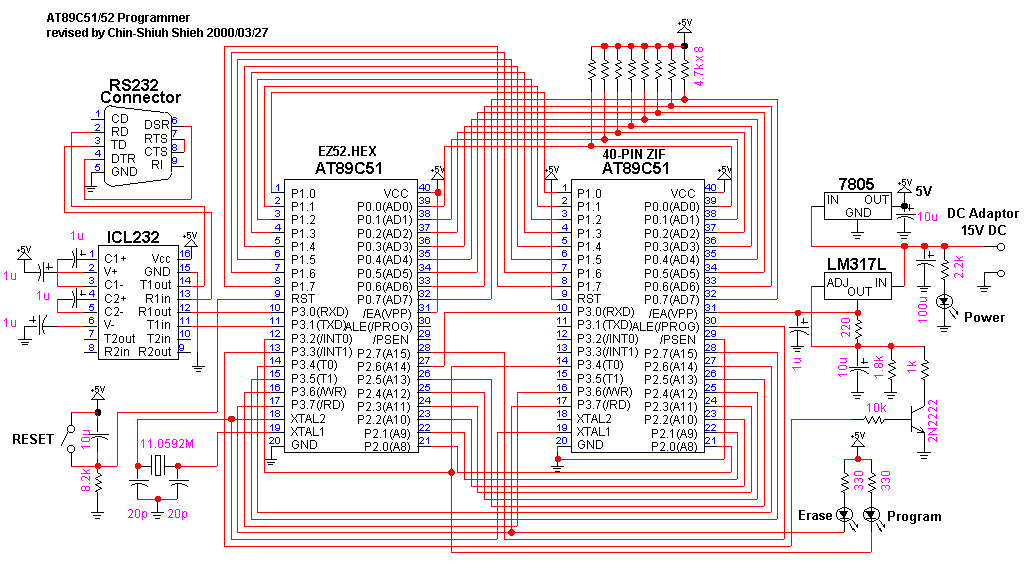
Feb 12, 2013 I am trying to program an AT89C51, microcontroller (8051) but I am not sure on which programmer/burner to use.
But since you jumped through all of those hurdles, the hard work is over and it's smooth sailing from here on. Hopefully you were able to get through the previous steps without any problems--so now let's get on with our first program. For the sake of simplification, let's categorize the function of the microcontroller into three categories: Control, sensing and communication.
We'll leave the details of how to develop each of these functions, and delve into these details as we write the various programs. Note that there are many ways to program these functions. For the first program, we'll make the microcontroller 'control' something. And as you know from the previous post, we'll be using an LED for this purpose. Basically, we will turn the LED on. Boring, right? Well I need to start somewhere! Cluefinders Math Free Download.
How To Load Program For At89c51 Controller. How to burn or program PIC Microcontroller? How to program or burn. Handling of electrical load. How To Load Program For At89c51. The microcontroller has built. The Atmel AT89C51 is an 8051-based Fullly Static. How to burn or program PIC Microcontroller? We are pursuing our project. We want to load program in intel p8051ah microcontroller. AT89C51 microcontroller. Program For 8051 Microcontroller.
As I take you through the experience of programming, I will add more complexity a little at a time so you are easily able to wrap your head around these important concepts. So at this point you're probably asking.how do we make a program to control an LED? Well, it's really easy: We will simply tell Pin0 on PORTB to output 5 volts. Remember that this is the pin to which the positive lead (anode) is connected. The first key in this scenario is 'output, ' and the next is '5 volts.' There is a way we can tell a particular pin to be set to be an output from the MCU.
Once a pin has been set to provide output, you will then be able to control that pin and make it either high (5 volts) or make it low (zero voltage). And since there are only two states for this pin in the output mode (5v or 0v), and only two states for the mode itself (input or output), you only need to set the value to either logical 1 or a 0. Note that this must be accomplished for each pin we wish to use in our circuit.
But before we get to plugging in a 1 or 0, let's talk about input versus output. When a pin is in input mode, it is listening for a voltage. When the pin is in output mode, the it can be charged at 5v, or not charged at 0v.
There are many ways to do this. This is not to confuse you, but rather to make things simpler.
I will be introducing you to one of the many ways to accomplish this task, and later I will explain some other methods while writing other programs. Note however that while this first method is great for introducing the concept, it's probably not as good in practice.
Therefore you will see other methods in future programs that will leave contextual pins (those pins on either side of the pin of interest) unaffected, as they may very well have been previously set in the program. But since we're writing a simple program, we won't worry about this complexity at this time. To pick the output mode for a pin, you will use the Data Direction Register (DDR).
What is a register?!? Don't let this worry you. A register is simply a memory location that makes the microcontroller react in some way. We use a register to set a state for the microcontroller, or make the microcontroller do something. It's like reflexes, or tickles.